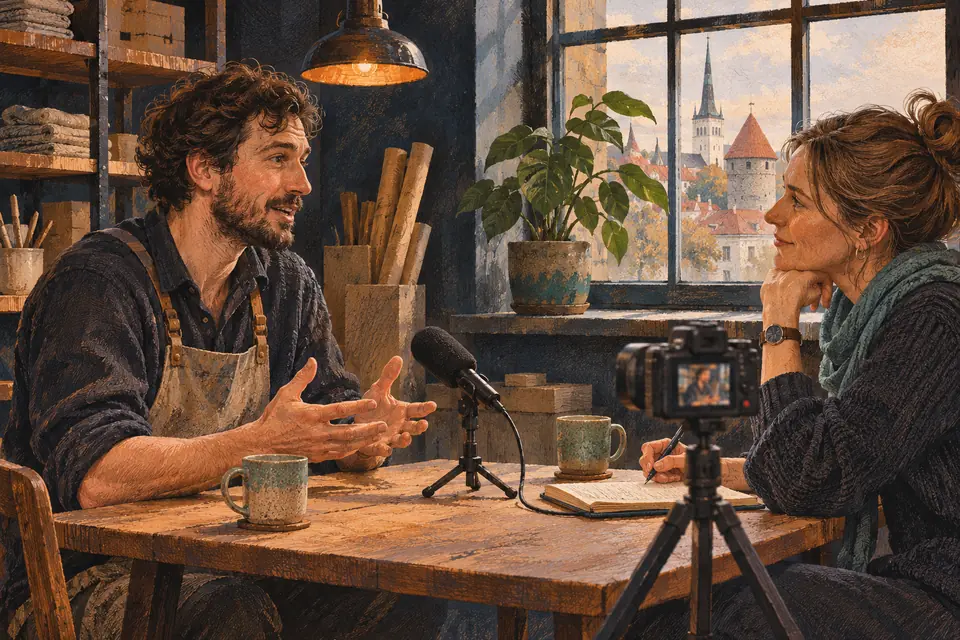
People are more willing to contact a business when they have already seen and heard the people behind it. Here is what a video interview can do for a salon, café, shop, craftsperson or consultant in Estonia, how filming with Julia Dit works, where the finished video is published and what it costs—with no promises of overnight results.
Why video interviews work for small businesses
In a small company, the main asset is people: the owner, the stylist, the chef, the consultant. Customers come to them, and they want to understand them before the first visit. Your website and price list answer “what do you sell?”; an interview answers “who are you, and can I trust you?”. Viewers see your face, hear your voice and the way you talk about your work, and the first step becomes easier.
An interview is a calm format. It is not an ad full of loud promises but a conversation: how you started, what you are good at, how the work gets done and what makes your approach different. This kind of material does not go stale in a week—you can keep showing it for months.
- Trust before the first contact: customers get to know you in advance and arrive knowing what to expect.
- Answers to frequent questions: how to book, what the price depends on, what to bring, how long it takes. You can send a link instead of a long chat.
- The people behind the sign: the team, the workshop, the kitchen, the process—things a product photo cannot show.
- Material for several channels: one filming session gives you a full video, short clips, quotes for posts and text for your website.
- Expertise without pressure: you explain how you work, and viewers decide for themselves whether it suits them.
- Question before buying
Pick one decision a customer has to make.
- Conversation and example
Show an object or a process and explain how you make the decision.
- Publish and follow up
Share a short clip with a complete answer and link to the relevant service.
Who Julia Dit is and how she helps
Julia Dit is a media partner of Tallinn Business Connection (TBC). At TBC she leads the media side: video interviews, filming and editing, social media content and business promotion. Julia Dit helps you shape the topic and the questions, put the scenes together and edit the video so that it makes sense to someone who is seeing you for the first time.
Technical work—websites, forms, chatbots, automation—is handled by another TBC specialist, so you can order the video and the page it links to together and get a single list of deliverables. Everything TBC offers is on the services page.
How filming a video interview works, step by step
The process is the same for a salon, a café or a consultant—only the place and the story change. This is the path from your request to publication.
- Request and a short call. You tell us about your business, your goal and your audience, and send a link to your website or social media page. We discuss where the video will be used, when you need it and what budget you have in mind.
- Proposal. We agree on the format, approximate length, final versions, publishing platforms, price, schedule, number of revision rounds and payment terms. Scope, price and advance payment are settled before any work starts.
- Questions, together. Julia Dit prepares the topic and a list of questions, and you add what your customers ask most often. You see the questions in advance, so there are no surprises on the day.
- Location and time. We choose a place where it feels natural to see you: the salon floor, the café in a quiet hour, the workshop, the office. We check noise, light, permission to film and the consent of everyone who will appear on camera.
- Filming day. We record the conversation and extra footage: hands at work, the product, the shop window, the team. Feeling nervous is normal—you can repeat an answer, and editing removes pauses and slips.
- Editing. We build the story, add name captions and, where agreed, subtitles and versions for different platforms: horizontal for YouTube and websites, vertical clips for Reels and Shorts.
- Approval. You watch the draft and send one combined list of comments within the agreed time. We check facts, names, captions, sound and links. Nothing is published without your approval.
- Publishing and handover. We publish the video on the agreed platforms and hand over the files and the links to the publications.
Rights to film people and to use music, images and the finished video are agreed before release, together with how the raw footage is stored and handed over.
Publishing on YouTube: title, description, chapters and short clips
YouTube is the main home for the full interview: the video is easy to find through search, embed on a website and share as a link. Which channel it appears on, and who manages that channel, is set out in the proposal.
- Title. Clear and with keywords: who you are, what you do and where. For example: “Tallinn bakery: how a new cake is born—interview with the owner”. No clickbait.
- Description. Two or three sentences about the business and the conversation, your address or neighbourhood, a link to your website or booking page, and your contact details.
- Chapters. Timestamps in the description split the interview into topics, so viewers can jump straight to the question they care about. Under YouTube’s rules, the first timestamp must be 00:00, there must be at least three timestamps in ascending order, and each chapter must be at least 10 seconds long.
- Short clips. The liveliest answers become vertical clips for Shorts. YouTube allows Shorts of up to 3 minutes in a square or vertical format, but a single idea rarely needs more than a minute.
- Thumbnail and subtitles. A frame with a face and a short caption helps people pick the video from a list, and subtitles make it clear without sound and easier to follow for people who read another language better.
Your interview on the TBC website and on your own site
If publication on the TBC website is part of your order, the interview appears on a page or in an article on tbcest.eu with a short text about your business and links to you. The video file itself is not stored on the TBC server: the site embeds the YouTube player through youtube-nocookie, and the player only loads after a visitor clicks “Watch the video”.
It is worth putting the same video on your own channels too—it works best where customers make their decision:
- on your “About us” page, to introduce the owner and the team;
- on a service page, next to the price and the booking button;
- in newsletters and messengers, as an answer to a question new customers often ask;
- at meetings, fairs or in a presentation, instead of a long introduction;
- via a QR code on the counter, the menu or your business card, so guests can watch the story of the place.
A YouTube video can be embedded on your website without uploading the file to your own hosting. If you do not have a website yet, or the video has nowhere to send viewers, a page with a contact form and a QR code can be ordered from TBC together with the interview.
Social media: Facebook, Instagram, Reels and LinkedIn
On social media, an interview is not a single post but a series: an announcement, several clips, a quote, an answer to a customer’s question. One filming session can give you material for several weeks.
- Facebook. The full video or a clip with a link to YouTube and your website. In 2025 Meta announced that all videos on Facebook would be shared as reels, with no length or format restrictions.
- Instagram and Reels. Vertical clips with subtitles, one idea per clip. In January 2025 Instagram said that reels of up to 3 minutes are eligible to be recommended to people who do not follow you yet. Shorter is usually easier for viewers.
- LinkedIn. A good fit for consultants, accountants, IT and other B2B services: a clip where you explain your approach and a post with the main idea of the interview.
- Stories and messengers. An announcement that the interview is out and a link for your regular customers.
For more on promoting video on Facebook, Instagram, Reels and YouTube, see our article on video marketing for small businesses.
How to prepare for your video interview
A good interview starts a week before filming, not on the day. A little preparation saves time and keeps the conversation natural.
- Pick one main message: what viewers should remember about you after watching.
- Write down the 3–5 questions customers ask most often—they make the best interview questions.
- Check the facts: prices, address, opening hours, service names, and the names and roles of everyone on camera.
- Prepare the space: tidy, quiet, background music off and, if needed, permission from the building manager.
- Ask staff and guests whether they agree to appear on camera; anyone who does not agree is not filmed.
- Choose what to show: a product, a process, a tool, a display, a finished piece of work.
- Dress the way you usually do with customers; fine stripes and large logos of other brands are distracting on camera.
- Decide where the link in the video leads: your website, a booking page, a form or a phone number that someone will actually answer.
- Name one person on your side who approves the draft and checks the facts.
There is no need to learn your answers by heart. Know the topic and speak the way you would explain it to a customer at the counter.
An honest look at results: what an interview can and cannot do
An interview is a tool for building trust, not a sales button. We do not promise a particular number of views, enquiries or sales: they depend on your offer, price, audience, season, how regularly you publish and how you promote. Our commitment is the materials and actions agreed in the proposal.
What an interview can do: show the people behind the business, answer frequent questions, give you material for your website and social media for several weeks and help a new customer take the first step. What it cannot do: replace good service, reviews, a clear price and a contact that works. One video rarely changes everything at once; consistency works better—for example, an interview every quarter plus short clips every month.
Any budget for paid promotion on social media is listed separately and is not included in the filming price.
What a video interview costs: one-off or subscription
You can order a single interview on its own. The guide price is €150 per interview excluding VAT; this is a pilot price. Length, versions and publications are listed in the proposal, and the final amount with taxes and any required costs is shown once the task is agreed. Travel, venue rental, guest specialists, licences, translation and advertising budget, if needed, are itemised separately in the estimate.
If you want consistency, a monthly subscription to TBC services is more convenient. There are three plans—START, BUSINESS and PREMIUM—with preliminary prices of €99, €199 and €399 per month. You can subscribe for 1, 6 or 12 months. Prices and volumes are still preliminary; the final terms are set in the contract.
| Service | START | BUSINESS | PREMIUM |
|---|---|---|---|
| Website support | 1 hr | 2 hr | 4 hr |
| Advertising posts | 1 | 2 | 4 |
| Short videos | — | 1 | 2 |
| Video interviews | — | — | Once every 3 months |
| IT consultations | 0.5 hr | 1 hr | 2 hr |
| Social media promotion | — | 1 channel | Up to 2 channels |
| Company directory listing | Included | Included | Included |
| Monthly report | Summary | Summary | Detailed report |
Only PREMIUM includes an interview: one every three months. START and BUSINESS do not include interviews, but anyone can order an interview separately, with or without a subscription. Besides media, every plan includes website support hours and IT consulting. Compare the plans and terms on the subscriptions page.
Order an interview or choose a subscription
If you want customers to see the people behind your business, start with one interview. Order an interview and describe your goal: what your company does, who the video is for and where you want to show it. Julia Dit will suggest a format, questions and a publishing plan, and you will know the price and timing before work starts.
If you want a regular interview—one every three months—plus videos and posts every month, choose a PREMIUM subscription. If you only need an interview now and then, order it separately. Have a question that is not about video? Contact us.